The Luopan Is Not a Formula Calculator: Learning to Read the Land First

Before studying the Qing Nang Jing 青囊經, often translated as the Classic of the Green Satchel, I approached the luopan as though it were a formula calculator.
I thought that once I measured the direction, identified the appropriate formula and completed the calculations, the compass would reveal the answer.
My study of the classical texts has changed that understanding.
The lesson I now take from the Qing Nang Jing is not that formulas are unimportant. Classical Feng Shui contains sophisticated systems for analyzing direction, water movement, landforms, timing and qi. The deeper warning is against imposing those formulas on an environment that has not first been understood.
A formula does not replace observation.
A compass does not replace the land.
And a technically correct calculation can still be applied incorrectly when the practitioner has misunderstood what the environment is actually doing.
What Is the Purpose of a Luopan?
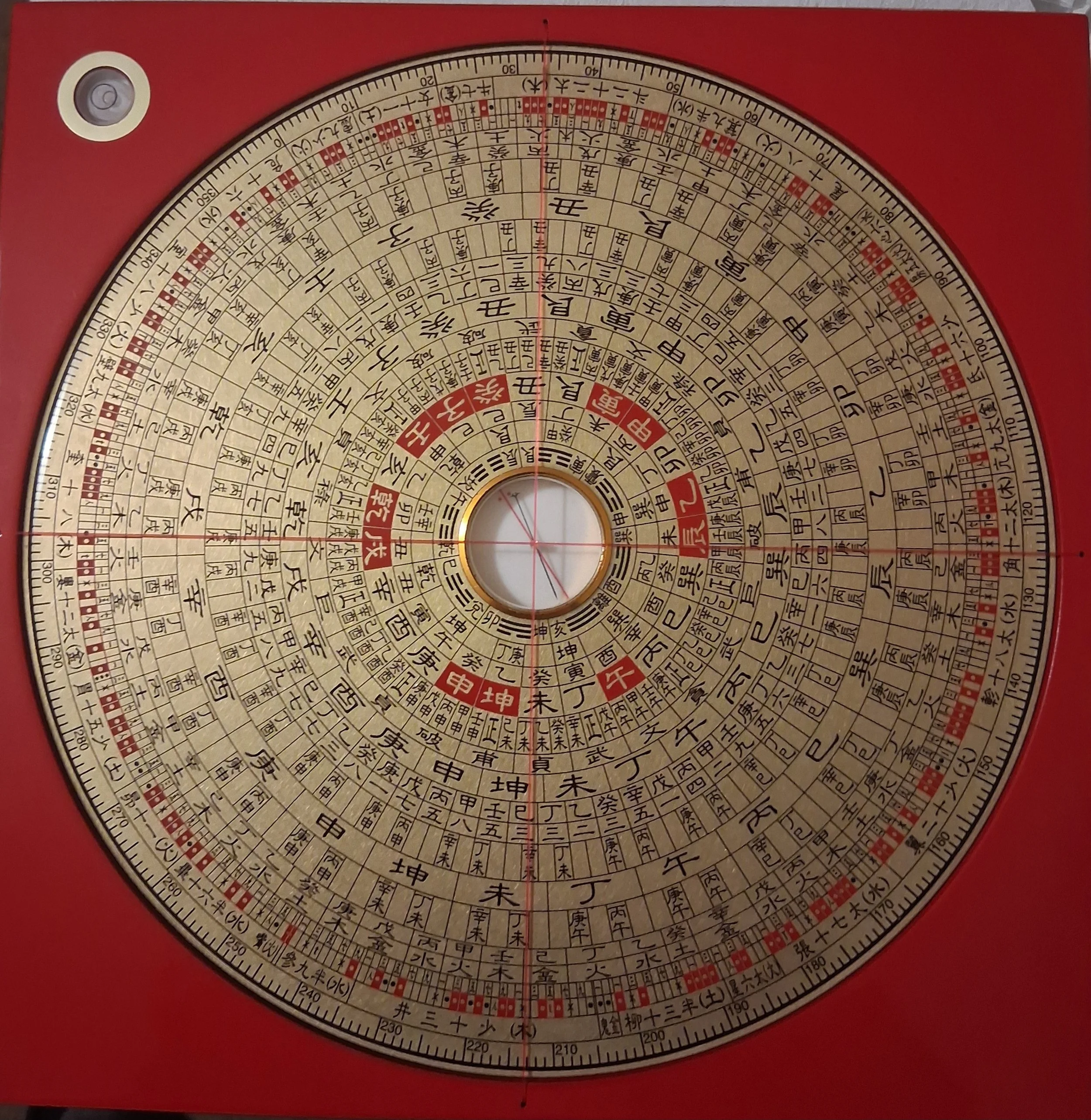
My Feng Shui Land Form Compass (San He) from Formosa Ar
A luopan is more than a directional compass. Its rings organize layers of classical Feng Shui knowledge, including mountains, branches, stems, trigrams, water methods, directional relationships and other systems of interpretation.
But the luopan does not independently decide which features of the environment matter.
The practitioner must first identify:
Where the land rises and falls
How the larger terrain approaches the property
Where water enters, gathers and exits
How roads, drainage systems and neighboring structures redirect movement
Whether the location receives, contains or loses qi
How the building is positioned within that larger environmental pattern
Only after those relationships are understood can the luopan help measure and classify them accurately.
The instrument completes the observation. It does not replace it.
From Formula First to Landform First
My former sequence was often:
Measure → calculate → apply the formula.
My approach now is:
Observe → identify the environmental pattern → measure → calculate → test the formula against the land.
That shift may appear small, but it changes the entire consultation.
Instead of standing at the front door and immediately trying to assign a directional formula, I begin farther outside the building.
I examine the mountains, hills, ridges, valleys, roads, rivers, creeks and drainage patterns that influence the property. I look at how movement approaches the location, how it circulates and where it departs.
In classical terminology, this means understanding the larger dragon, the water and the formation before concentrating on the internal arrangement.
The external environment establishes the conditions within which the building operates.
Furniture and decoration may influence how a room feels, but they cannot correct every problem created by an unsuitable location, poor orientation, aggressive roadway, eroding slope or uncontrolled water exit.
Reading Nashville and Middle Tennessee
This landform-first approach is especially important in Nashville and Middle Tennessee.
Our environment is shaped by the Cumberland River, the Central Basin, surrounding Highland Rim, rolling limestone terrain, tributaries, floodplains, ridges and rapidly changing road systems.
Two businesses may have similar floor plans and face the same compass direction, yet experience very different outcomes because their larger environmental settings are different.
One location may be supported by an embracing road, protected rear landform and controlled water exit. Another may be exposed to fast traffic, descending terrain or drainage that pulls movement away from the property.
The compass direction alone cannot explain that difference.
The land can.
This is why I study Nashville businesses, neighborhoods, cultural centers and public locations from the macro environment inward. I begin with the regional terrain, narrow the analysis to the local landforms and water movement, and then examine the building’s orientation and interior flow.
Formula Must Serve the Environment
Classical formulas are valuable because they allow the practitioner to recognize and describe relationships that may not be obvious at first glance.
However, the formula must serve the environment.
The environment should never be forced to fit the formula.
When observation and calculation appear to contradict each other, the answer is not always to discard the land and trust the chart. It may mean that the practitioner has selected the wrong reference point, misunderstood the water entrance or exit, measured the wrong orientation, or applied a method at the wrong scale.
The discrepancy becomes an invitation to investigate more carefully.
This is one reason my continuing study of the Qing Nang Jing, Han Long Jing and Yi Long Jing matters to my practice. These texts are teaching me to see beyond isolated compass readings and recognize the living relationships among terrain, water, movement, orientation and structure.
How This Changes My Consultations
Today, I do not approach a property asking only:
“Which formula applies here?”
I begin by asking:
“What is this environment doing?”
Where is movement coming from?
What contains it?
What accelerates it?
What disperses it?
What does the building receive from its surroundings?
Only then do I use the luopan to clarify the directional and technical relationships within the pattern I have observed.
The result is a more grounded form of Classical Feng Shui—one in which calculation supports reality rather than replacing it.
Begin With the Land
The luopan remains one of the most important tools in my practice. My respect for it has increased, not diminished.
I simply understand its purpose differently.
It is not a machine that produces automatic answers. It is a precision instrument held within a larger process of environmental observation, classical reasoning and professional judgment.
Before applying the formula, read the land.
Before prescribing the solution, understand the water.
Before changing the interior, examine what the building is receiving from outside.
That is the direction in which my practice is developing: from the environment inward, from observation to measurement, and from classical principle to practical application.
White Crane Feng Shui provides landform-first Classical Feng Shui analysis for homes and businesses in Nashville and Middle Tennessee. A consultation begins by examining the larger environment, water movement, roads, landforms and building orientation before recommending internal changes.
Is your property gathering supportive movement—or allowing it to pass by? Contact White Crane Feng Shui to begin with a preliminary environmental review.