Classical San He Feng Shui Analysis Public Series: K&S World Market 5861 Charlotte Pike Continued
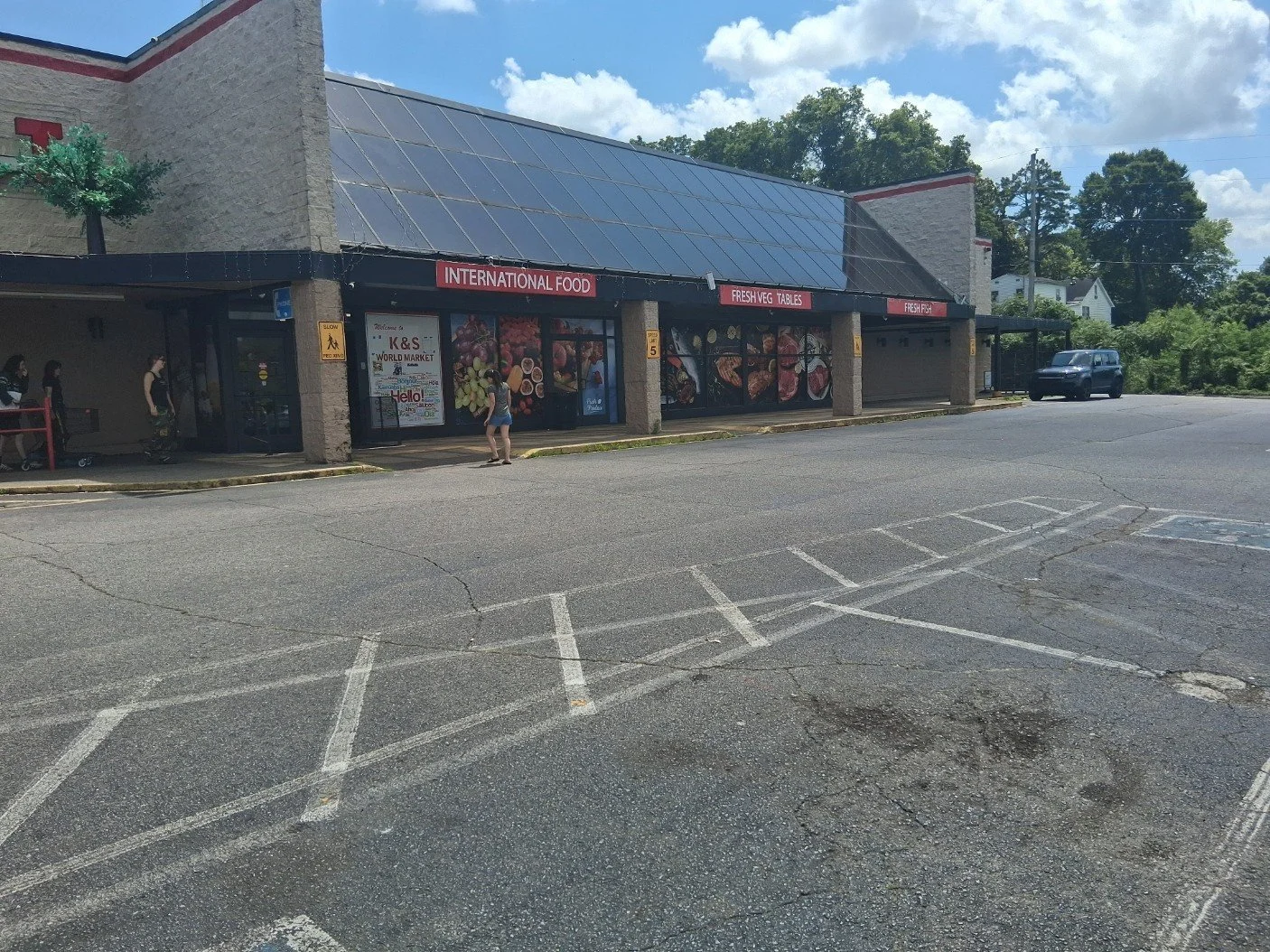
When K&S World Market opened its second Nashville location on Charlotte Pike around early 2006, the expansion represented more than ordinary business growth. James Sun a Chinese immigrant-founded international market that began in South Nashville was extending its reach into West Nashville, making culturally specific foods and ingredients accessible to a broader part of the city. Over time, K&S became an anchor within a significant international commercial cluster that includes Vietnamese, Chinese and other immigrant-run restaurants and food businesses. The Charlotte Pike location therefore holds both commercial and cultural importance: it helped connect Nashville’s established residents, immigrant communities and curious food shoppers through everyday access to the foods, ingredients and culinary traditions of many countries.
Why activity does not always become prosperity
A field-informed San He landform analysis, rooted in Yang Gong water and landform methods, of how Richland Creek, land forms, and immediate urban drainage combine to shape success and Nashville Tennessee’s Asian Cultural Heritage.
The property has genuine activity and support, but weak incoming qi and rapid outward movement make stable collection difficult.
K&S World Market on Charlotte Pike is active, visible, and culturally meaningful. Yet its larger creek system and immediate commercial frame reveal a consistent problem: movement is stronger than retention. Water enters the larger landform through Extinction, develops through the basin, and leaves through Peak. At the site itself, traffic and stormwater are both directed toward a weakly collecting northern opening.
This does not mean the location lacks qi. It means that the site has difficulty holding and consolidating what it receives. The strongest interpretation is therefore not “no prosperity,” but activity that is harder to convert into stable accumulation.
What the Site Visit Revealed
The immediate frame has genuine support. The building benefits from a strong Black Turtle and Green Dragon, an elevated position, and meaningful containment along its rear and side. The front condition is less effective.
The front does not collect calmly
The parking lot provides open space, but it functions as a weak or incomplete Ming Tang. The northern approach is long, exposed, and sloping. The Red Phoenix is only weak to moderate, while the neighboring structure provides a virtual rather than natural White Tiger.
Urban water confirms the retention problem
During the site visit, visible moisture, water vapor, grade changes, curbs, drains, and the alley revealed a micro-water process that aerial imagery alone could not confirm. Stormwater descends from the higher southwest hill slope, passes through the western and northern portions of the property, is intercepted by multiple drains, and ultimately moves toward the same general northern main entrance.
· Incoming water is relatively fast and steep rather than gentle and meandering.
· Multiple storm drains interrupt or redirect collection.
· Traffic and water share the principal outward opening.
· The parking-lot lip provides some checking action, but not enough to create strong retention.
· Engineered drainage protects the property while also confirming how quickly water must be discharged.
Site Diagnosis
The frame is supported from behind, but the front receives qi weakly and releases it quickly. The main limitation is not the absence of qi—it is the inability to gather and hold it.
Sitting and facing
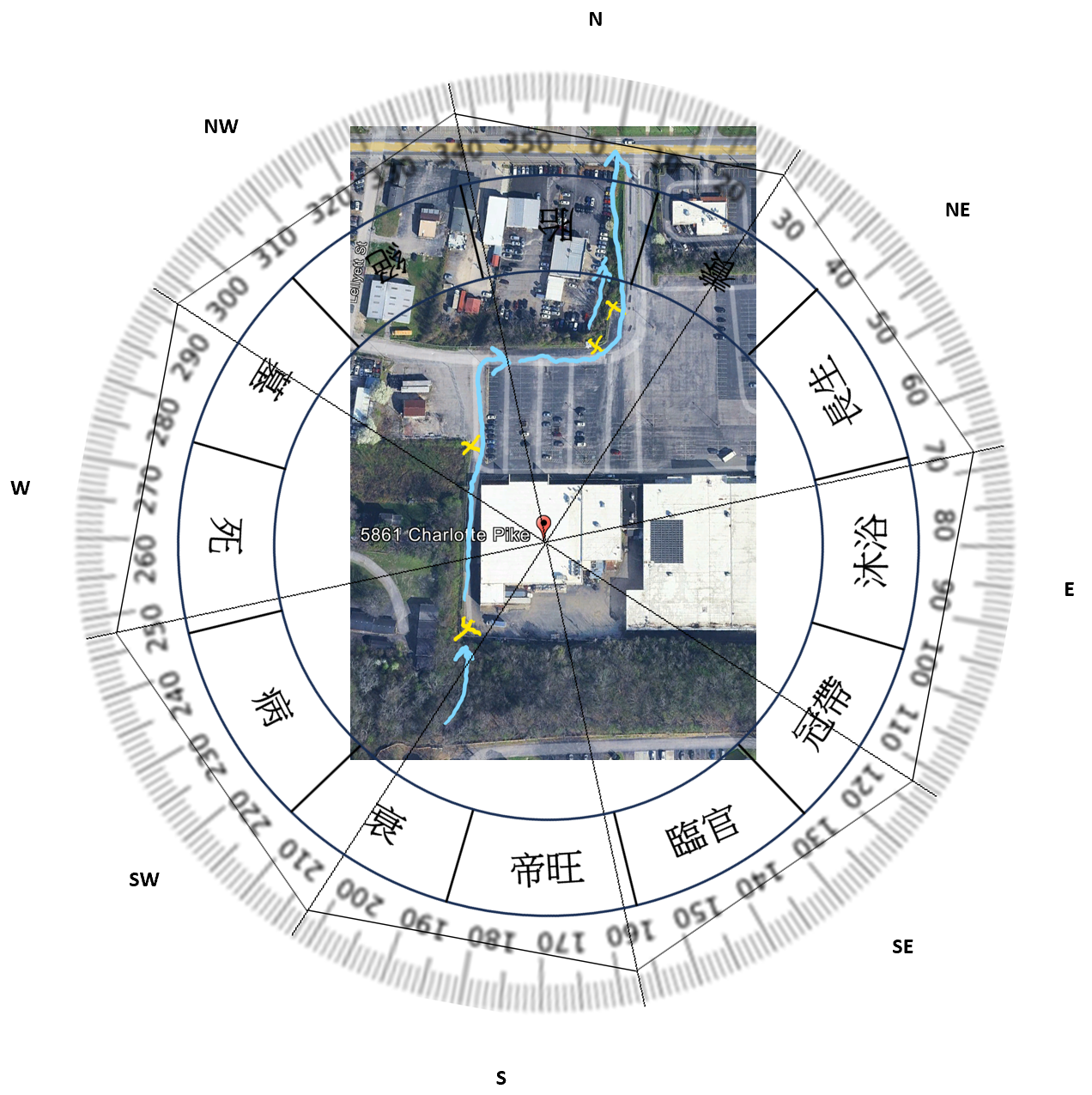
Using the 170° Bing sitting to establish the Yang Fire frame sequence, the rear falls in Peak 帝旺 while the 350° Ren facing falls in Embryo 胎. This describes a building with stronger support behind it than development at its front qi mouth.
How the Wider Landscape Moves Water, Qi & Fortunes
The governing meso-scale system is the McCabe/Richland Creek lowland. The surrounding elevation, channel openings, creek bend, marsh, roads, and interstate help reveal where the land and water receives, reorganizes, and discharges qi.
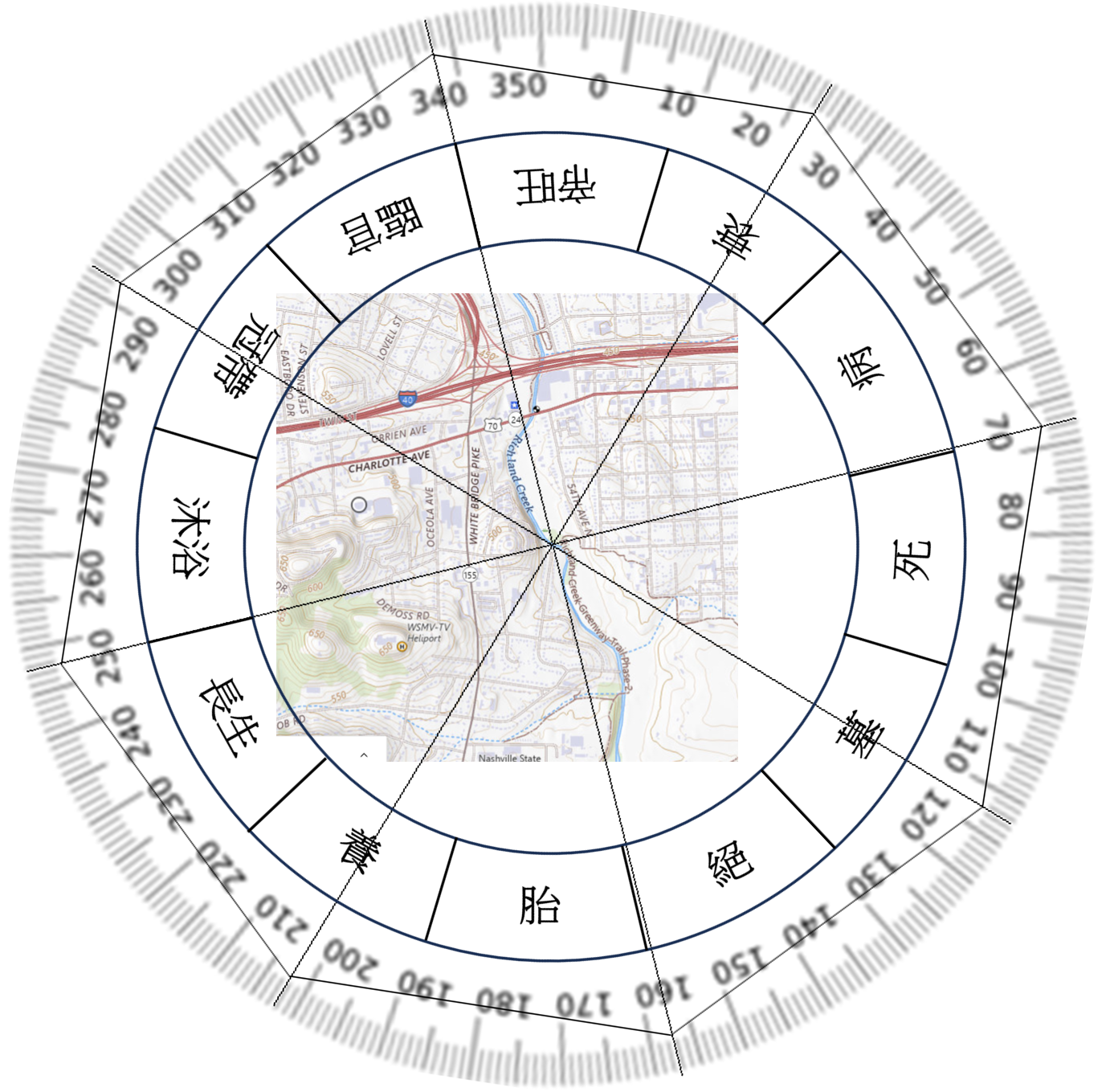
The center is a zone—not merely a point
The center is a point that reorganizes qi. This is the pivotal location that everything else is measured. The collecting-center zone is located on a bend in Richland/McCabe Creek, in the marsh near Meadowcrest Lane. Here the creek opens, slows, and reorganizes within the lower ground. The center is therefore identified by the behavior of water and landform, not by geometric convenience.
Water Entrance, Center, and Exit
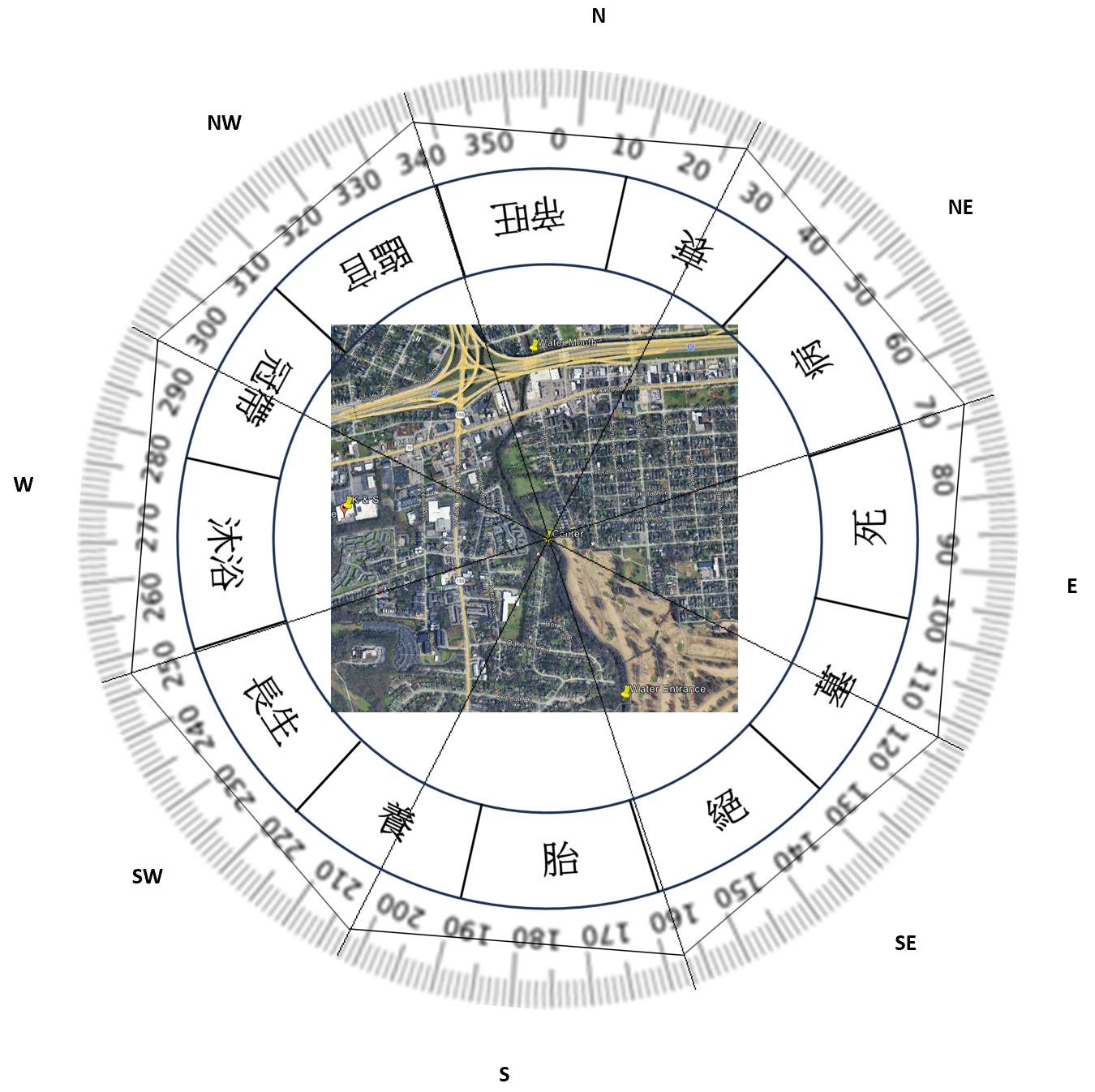
Interpretation
The entrance-to-exit relationship is unfavorable. Qi arrives in near Richland Creek Greenway birdge, correlated with the Extinction phase 絕, receives some opportunity to reorganize within the basin, and then leaves through the Peak Phase 帝旺 near I-40. In practical terms, the land can generate movement and activity, but the strongest qi is not well retained.
The water and land form is weak and poorly retained, yet not empty. The bend, marsh, lowland, and enclosing terrain still perform meaningful work.
K&S location Within the land form & Water System
K&S lies west of the creek and occupies the Bath phase portion of the larger energetic system. The Bath phase is active and socially expressive, but it is also transitional and inconsistent. This makes it a meaningful correspondence for a multicultural market that attracts movement, exchange, memory, and emotional connection without automatically producing stable accumulation.
BATH-PHASE EXPRESSION
High activity and community connection can coexist with instability. Visibility is not the same as retention.
Why the creek’s Qi is received indirectly
The store is not located beside the bureau center or directly on the primary creek channel. Distance, intervening terrain, White Bridge Pike, roads, and developed parcels weaken the immediate transmission between the larger water system and the site’s location. The land and water system still remains relevant, but the store receives its influence indirectly.
Conclusion: More Than a Market
K&S World Market on Charlotte Pike is more than a grocery store. When this immigrant-founded business expanded from South Nashville into West Nashville around 2006, it made foods, ingredients and culinary traditions from around the world accessible to a broader part of the city. Over time, it became an anchor within Charlotte Pike’s international business community—a place where immigrants could find familiar tastes of home and where other Nashvillians could encounter cultures beyond their own.
The San He analysis reveals a landscape filled with movement but challenged in its ability to hold what it receives. In the wider land-and-water pattern, weak qi enters from the southeast, develops as it moves through the creek basin, and leaves through the strongest phase in the north. At the property itself, the building has meaningful support behind and beside it, yet the exposed parking lot, sloping approach, storm drains and shared traffic-and-water exit make stable collection difficult.
This does not describe a place without energy or value. K&S clearly attracts people, activity and emotional connection. Its position within the larger landscape corresponds with the Bath phase associated with social exchange, diversity, movement and instability. That symbolism is especially meaningful here: the market continually brings different people, languages, foods and traditions together, even though the physical environment has difficulty converting that activity into lasting accumulation.
The landform evaluation is scored a 2/5, but that number is not a judgment of K&S’s cultural importance or the people who have sustained it. It describes the environmental challenge the business has had to work within. In fact, K&S’s longevity and community significance may be more impressive because they were developed within a landscape that offers genuine support but does not make retention easy.
Ultimately, K&S Charlotte Pike demonstrates that the meaning of a place cannot be measured by landform alone. Feng Shui helps us understand the environmental conditions, but people give those conditions purpose. Through entrepreneurship, resilience and cultural exchange, K&S has become a meaningful part of Nashville’s evolving identity—a place where the world is made more familiar, one visit and one shared meal at a time.
What Is Your Business Environment Revealing?
Every Nashville business operates within a larger pattern of land, water, roads, buildings and human movement. These conditions may help a business receive and retain activity—or quietly contribute to exposure, instability and loss.
White Crane Feng Shui invites Nashville small-business owners to apply for a Complimentary Classical Feng Shui Forensic Analysis. This high-level review examines the visible landform and movement surrounding your business to identify potential environmental strengths, vulnerabilities and patterns.
The complimentary analysis reveals what may be happening and why. It does not include corrective formulas, renovations or a complete implementation plan.
Business owners who want to move from diagnosis to solutions may continue with a Professional Classical Feng Shui Consultation. This paid consultation includes detailed intake, field verification, confirmed measurements, a deeper analysis of the property, prioritized corrections and practical implementation guidance aligned with the business’s goals.
If your business attracts attention but struggles to retain customers, revenue, momentum or stability—or if you want to understand your location before making an important investment. Email me brad@whitecranefengshui.com to apply for a complimentary forensic analysis.
First, understand what the environment is doing. Then determine what to do about it.
Classical landform first. External Landforms determines internal Solutions.